
Gardening, Sustainable Agriculture
The Secret Workforce: How to Attract Pollinators for Thriving Crops and Gardens
Jun
Have you ever looked at a blossoming tomato plant or a flowering zucchini on your balcony? It is frustrating to watch the tiny buttons of fruit suddenly wither and drop off. Most of the time, a failing crop is simply the result of a quiet, empty garden. Therefore, if you want to fix this and boost your yields naturally, you must learn how to attract pollinators to your cultivation space.
Across India, a silent crisis is unfolding from sweeping agricultural fields to compact concrete balcony gardens. Our essential, invisible workforce of native pollinators is missing in action. Consequently, without these tiny partners, our local food systems simply cannot function. Transitioning your land to chemical-free methods is an excellent first step. However, you must actively invite these beneficial insects back into your ecosystem.
Fortunately, restoring balance to your land is entirely within your control. For example, when you explore natural farming practices, you quickly realize that biodiversity is your greatest asset. By understanding who these beneficial bugs are, you can make smarter planting choices. As a result of planting the exact flowering varieties they crave, you can easily transform your growing space into a buzzing, highly productive sanctuary.
How to Attract Pollinators: Meet Your Native Workforce
When most people think of pollination, they picture a classic commercial honeybee hive. However, India’s local ecosystems rely on a remarkably diverse cast of characters finely tuned to our climate.
The Rural and Forest Specialists
Deep in rural landscapes and forest borders, pollination happens on a grand scale. Here, the Rock Honeybee (Apis dorsata) rules the upper canopy. These large, wild bees build massive open-air combs on tall trees and rocky cliffs. They are highly resilient and travel incredible distances to forage, making them vital for rural biodiversity.
Alongside them work Giant Carpenter Bees (Xylocopa spp.), the glossy black giants that nest in dead wood, and various species of Hawk Moths, which take over the night shift to pollinate pale, evening-blooming wild trees. Even Fruit Bats play a massive role in rural areas, transferring pollen between large-flowered tropical trees.
The Agricultural Champions
In our food fields, the native Indian Honeybee (Apis cerana indica) is the true backbone of crop production. These cavity-nesting bees are incredibly efficient at managing local weather patterns.
They are joined by Hoverflies (Syrphid flies), which cleverly mimic the yellow-and-black stripes of wasps to keep predators away while visiting open field crops. Solitary bees, such as leafcutter and mason bees, do not live in social hives but drill tiny holes in soil or stems, providing focused pollination for specific local legumes and oilseeds.
The Urban Survivors
You do not need acres of land to witness this magic. In city parks and apartment balconies, the Little Honeybee (Apis florea) frequently sets up small, delicate combs in low garden bushes.
Even smaller are the Stingless Bees (Dammer bees), which are no larger than a gnat. These harmless creatures love nesting in old wall crevices and are brilliant at pollinating potted herbs. Bright butterflies like the Common Mormon and nectar-seeking Sunbirds complete the urban team, bringing life back to concrete environments.
Red Alert: Why Our Tiny Partners Are in Trouble
We often take these creatures for granted. We assume they will always be around to fertilize our food. However, modern human habits are putting immense pressure on pollinator populations across India.
For instance, the widespread use of harsh chemical pesticides in conventional farming kills beneficial bugs just as easily as it kills pests. At the same time, expanding cities and monoculture farming destroy their natural habitats. Growing just one single crop across miles of land eliminates their continuous food sources.
Furthermore, when we wipe out wild hedges, we create food deserts for our pollinators. We do the same when we replace native flowering plants with concrete or manicured lawns. Therefore, protecting these insects is no longer just an environmental ideal. Instead, it is a direct necessity for our own food security.
The Green Solution: Planting to Attract Beneficial Bugs
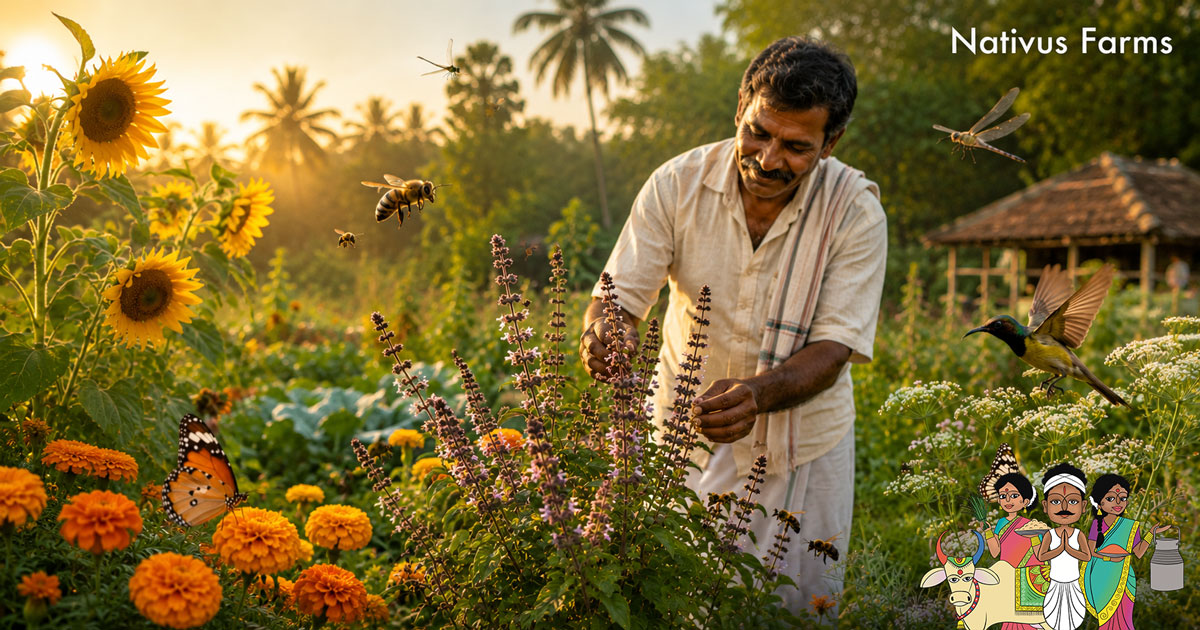
The most effective way to protect these creatures and boost your crop yields is to cultivate a continuous buffet of local flowering plants. When you intentionally design your farm perimeters or balcony spaces to attract Indian pollinators, you ensure that beneficial bugs always have a reliable food source near your main crops.
- Marigold (Genda): Whether planted as a farm border or tucked into a balcony pot, marigolds are an absolute must. Their bright yellow and orange petals act as highly visible landing pads for honeybees and hoverflies. As a major bonus for natural farming, the scent of marigolds naturally repels destructive root-knot nematodes and pests from your primary crops.
- Holy Basil (Tulsi): This sacred, aromatic plant produces continuous clusters of tiny micro-blooms. It provides a steady, year-round supply of high-sugar nectar that keeps stingless bees and native honeybees constantly hovering around your garden.
- Umbel Herbs (Fennel, Coriander, and Dill): If you let these herbs go to seed, they reward you with flat, umbrella-like flower clusters called umbels. These tiny, shallow blossoms are the favorite hunting grounds for hoverflies and tiny parasitic wasps whose larvae hunt down and eat crop-destroying aphids.
- Sunflowers (Surajmukhi): Perfect for farm perimeters or deep garden beds, the massive central disks of sunflowers are packed with heavy, protein-rich pollen. They act as a beacon for larger pollinators like carpenter bees.
- Night-Blooming Jasmine (Parijat): To support the nocturnal ecosystem, plant Parijat around your homestead. Its intensely fragrant white flowers open exclusively at dusk, releasing a powerful scent trail into the night air that guides evening-flying hawk moths straight to your space.
The Sensory Science: How Flowers Call for Help
Plants cannot move to find a mate, so they have evolved an incredible multi-sensory marketing system to convince pollinators to do the moving for them.
First, they use highly targeted color coding. Bees have specialized vision that makes them highly drawn to blues, purples, violets, and bright yellows. Interestingly, bees cannot see the color red—it simply appears black to them. Red and deep pink flowers are instead designed for birds, like sunbirds, who have excellent red-spectrum vision.
Flowers also use secret roadmaps called nectar guides. These are patterns of lines or dots radiating from the outer petals toward the center of the bloom. While invisible to human eyes, these patterns stand out vividly to bees under ultraviolet (UV) light, acting like runway lights directing an insect to a safe landing.
Finally, physical shape determines who gets the prize. Flat, open flowers welcome everyone, while deep, tubular flowers like hibiscus act as a secure lock-and-key system. They save their sweet nectar rewards exclusively for creatures with long tongues, specialized proboscises, or long, curved bills.
The Beautiful Accident: The Mechanics of Pollination
The most fascinating part of this relationship is that insects do not actually mean to cross-pollinate your crops. On the contrary, they visit a bloom with a completely selfish goal. They simply want to gather energy-rich nectar for food or protein-packed pollen to feed their young. However, the step-by-step choices you make to attract Indian pollinators create a beautiful biological accident. As a result, this accident ensures your vegetables grow to their full potential.
To begin with, friction builds up a positive electrostatic charge on an insect’s body as it flies through the air. Meanwhile, flowers hold a negative charge because they are grounded in the earth. Therefore, when a hairy bee lands on a flower, this electrical difference causes a physical reaction. The light, powdery pollen grains literally jump through the air and stick firmly to the bee’s body hairs.
Subsequently, as the insect crawls deep into the blossom to drink nectar, its body rubs against the flower’s male organs. When it flies to the next blossom looking for more food, some of that trapped pollen inevitably brushes off onto the sticky female organ. Thus, fertilization happens seamlessly, and a fruit begins to grow.
The Power of “Buzz Pollination”
Some of our most critical kitchen crops—including tomatoes, brinjals (eggplants), and green chillies—keep their pollen tightly locked inside hollow, straw-like anthers. Standard honeybees cannot get to it.
To unlock these crops, we rely on native carpenter bees for a technique called sonication, or buzz pollination. The bee grabs the flower and rapidly vibrates its flight muscles without moving its wings. This generates a loud, distinct buzz that creates a physical vibration. The vibration forces the hidden pollen to burst out like a tiny explosion, instantly coating the bee and fertilizing the crop. Without these native specialists, your favorite spicy curries and chutneys wouldn’t make it to the dinner table.
Frequently Asked Questions
Q1: What is the easiest plant to grow in an Indian balcony garden to attract bees?
Marigold (Genda) and Holy Basil (Tulsi) are the easiest and most effective options. Both thrive beautifully in pots, tolerate the warm Indian climate well, and produce continuous blooms that draw in small local honeybees and stingless bees year-round.
Q2: Why are my tomato and chili plants flowering but not producing any fruit?
This is a classic sign of poor pollination. Tomatoes and chillies require specialized “buzz pollination” from native bees to release their pollen. If your space lacks these insects or experiences low air movement, the flowers will dry up and drop off without setting fruit.
Q3: Are stingless bees safe to have around children and pets in an urban home?
Yes, absolutely. Stingless bees (Dammer bees) are completely harmless. Their stingers are underdeveloped and cannot hurt humans or animals. They are incredibly docile, making them wonderful, safe additions to urban household gardens.
Q4: How can I tell the difference between a harmful pest and a beneficial bug?
Harmful pests like aphids, mealybugs, and caterpillars typically stay still on your plants, chewing leaves or sucking sap. Beneficial bugs like hoverflies, ladybugs, and solitary bees are highly active, constantly moving from flower to flower or actively hunting down smaller insects.
Conclusion
Every single seed, fruit, and vegetable we enjoy is the result of a successful partnership between a flower and an insect. When you take deliberate steps to attract Indian pollinators by welcoming native flowering plants back into your farmlands and home gardens, you easily reverse the damage of recent decades. Moving away from harsh chemical sprays allows nature’s natural balance to return seamlessly.