
Sustainable Agriculture
Why Indian Farmers Still Wait for the First Rain to Sow Seeds
Jul
The Silent Calendar: Why Indian Farmers Wait for the First Rain (Even with Borewells)
Imagine standing in a parched field in rural Rayalaseema in late May. The air is so thick with heat you can almost chew it. The soil under your feet is cracked, resembling a jigsaw puzzle of dry clay.
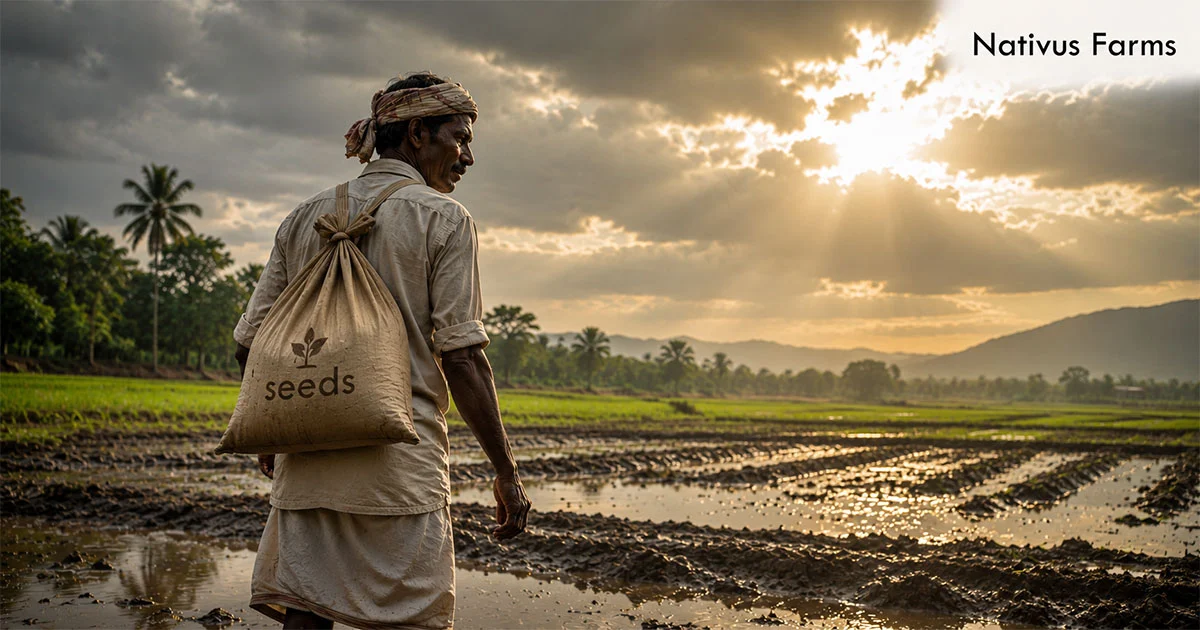
Right next to the field, a borewell pump sits ready. With the flick of a switch, a gush of cool groundwater could flood the dry earth. Yet, the farmer, clad in a simple cotton dhoti, stands still.
He looks up at the horizon, squinting at a distant, bruised-purple cloud. He chooses to wait.
To a modern city dweller, this seems illogical. We live in an era of instant gratification where technology solves every delay. Why would a farmer risk his livelihood by waiting for water from the sky when he has water right under his feet?
The answer lies in a beautiful intersection of ancient ecological wisdom, soil chemistry, and the deep, unseen rhythms of nature. Sowing a seed is not just about making dirt wet. It is about waking up the earth.
The Mirage of the Borewell: Why All Water Is Not Created Equal
To understand this patience, we must look at what happens when you pump groundwater onto scorching-hot summer soil.
Groundwater from borewells is often cold, hard, and heavily mineralized. When poured onto soil that has been baked by a 43°C summer sun, it can shock the ground.
Instead of welcoming the water, the superheated soil causes rapid evaporation. This leaves behind a crust of harsh salts on the surface. If a seed is sown in this artificial environment, it struggles to breathe.
In contrast, rainwater is a celestial chemical cocktail.
Lightning in the Sky ──> Splits Nitrogen Molecules ──> Dissolves in Raindrops ──> Natural Nitrate Fertilizer
During monsoon storms, lightning splits atmospheric nitrogen molecules. This nitrogen dissolves into falling raindrops, creating a highly diluted, natural fertilizer.
Rainwater is also soft, slightly acidic, and highly oxygenated. It arrives at the perfect temperature to gently coax a dormant seed out of its slumber.
Comparing the Sources: Ground Water vs. Monsoon Rain
| Feature | Borewell / Groundwater | Natural Monsoon Rain |
| Temperature | Cold; shocks sensitive seeds | Warm and matches ambient air |
| Chemical Profile | Often alkaline and rich in heavy salts | Mildly acidic and highly oxygenated |
| Nutrient Value | Poor in nitrogen; can cause salt buildup | Rich in dissolved atmospheric nitrates |
| Soil Impact | Can cause surface crusting | Softens and aerates the top soil |
The Awakening: How the First Rain Resurrects the Soil
Dry summer soil is not dead; it is simply holding its breath. Beneath the dusty surface, billions of native soil microbes, fungi, and beneficial bacteria have entered a state of deep hibernation called aestivation.
The first heavy monsoon shower acts like a grand alarm clock.
Within minutes of the first raindrop hitting the dust, a massive biological explosion occurs. Spores of Actinomycetes—a specialized group of soil bacteria—instantly wake up.
They begin to multiply rapidly, releasing a organic compound called geosmin.
At the same time, earthworms that burrowed yards deep into the earth to escape the summer heat feel the barometric pressure drop. They begin their slow journey back to the surface.
As they tunnel upward, they naturally aerate the compacted ground, turning the soil into a soft, spongy bed.
“To sow seeds before this biological awakening is like trying to plant a garden in a concrete block. The soil must breathe before it can feed.”
Reading Nature’s Signals: The Multi-Sensory Weather Forecast
Long before satellite imaging and weather apps, Indian farmers relied on a complex network of ecological signals to time their sowing. This traditional ecological knowledge is still passed down through generations.
Rather than looking at a screen, a farmer reads the landscape:
- The March of the Ants: When black ants begin carrying their eggs to higher, safer ground, it signals a major shift in humidity. Heavy rain is usually less than 48 hours away.
- The Song of the Frogs: The sudden, synchronized croaking of bullfrogs in dried-up ditches tells the farmer that moisture levels in the air have crossed the threshold for rain.
- The Dust Devils: When dry summer winds (called Loo in Northern India) suddenly shift direction and blow from the south or east, bringing a heavy, damp coolness, the monsoon has officially arrived.
- The Sky’s Canopy: The appearance of the Jacobin Cuckoo (the Chatak bird), which traditionally migrates ahead of the monsoon rains, is viewed as a reliable sign of oncoming showers.
The Alchemy of Petrichor: A Biological Green Light
We all know the intoxicating scent that rises from dry earth after the first summer rain. We call it petrichor.
For urbanites, it is a cue for nostalgia, hot chai, and window-seat musings. For a farmer, it is a precise biological broadcast.
Petrichor is the scent of geosmin mixed with plant oils secreted during the dry season. When rain hits the earth, it traps tiny air bubbles at the soil surface.
These bubbles shoot upward, popping like champagne bubbles and releasing the scent into the wind.
To a seasoned farmer, the strength and depth of this scent indicate how well the soil has absorbed the moisture. It tells them: The earth is ready. The soil has opened its pores.
Sowing is About Synchrony, Not Just Survival
In farming, timing matters just as much as water. Sowing is a high-stakes gamble.
If a farmer sows seeds too early using borewell water, the seeds may sprout unevenly. Some will struggle through the dry crust, while others will rot in the localized heat.
When a field is sown immediately after a heavy, soaking monsoon rain, the entire field germinates at the exact same time.
This synchronization is vital. When plants grow at the same pace:
- They share sunlight equally, preventing taller plants from shading out weaker ones.
- They develop uniform root systems that hold the soil together against erosion.
- Weeding and organic pest control become much easier to manage.
More Than Weather: The Emotional Pulse of the Monsoon
For an urban family, rain might mean a disrupted commute or a cozy evening indoors. For a rural farming family, the first rain is a profound emotional and spiritual rebirth.
Farming is one of the few professions where you must invest almost all your capital—buying seeds, preparing land, renting equipment—before you see a single rupee of return. Sowing is an act of absolute, terrifying faith.
When the first raindrops finally fall, the tension that has built up over months of dry heat melts away.
Children run out into the muddy fields, their laughter mixing with the sound of thunder. Elders offer prayers of gratitude to the earth.
The first rain represents a clean slate. It is the boundary line between survival and hope.
Reconnecting with Seasonal Wisdom
Our grandparents did not understand the seasons through digital forecasts. They understood them through touch, smell, and observation.
By keeping their hands in the dirt and their eyes on the sky, they lived in harmony with the natural world rather than trying to dominate it.
As we look for ways to live more sustainably, perhaps we can learn a lesson from the patient farmer standing by his borewell. Sometimes, the best course of action is not to force our own timeline, but to wait, listen, and trust the timing of the earth.
Frequently Asked Questions
Q1: Why is rainwater better than borewell water for germinating seeds?
Rainwater contains dissolved nitrogen absorbed from the atmosphere during lightning storms, acting as a gentle, natural fertilizer. It is also highly oxygenated, soft, and free of the heavy salts and minerals often found in deep groundwater, which can shock young seeds.
Q2: Can’t farmers just use drip irrigation instead of waiting for the monsoon?
While drip irrigation is excellent for maintaining growing crops, it cannot replicate the widespread drop in atmospheric temperature and rise in relative humidity that the monsoon brings. These macro-environmental changes are essential to trigger uniform seed germination across large fields.
Q3: What role do soil microbes play during the first rain?
During the hot dry season, soil microbes go dormant. The moisture and warmth of the first rain wake them up instantly. They begin breaking down organic matter, making vital nutrients like phosphorus and potassium bioavailable to the newly sown seeds.
Q4: How long do farmers wait after the first rain before they start sowing?
Farmers usually do not sow during the very first drizzle. They wait for a sustained, heavy downpour that penetrates at least 3 to 4 inches into the soil. Sowing too early in shallow moisture can cause the seeds to sprout and then wither if the rains take a brief pause.
Conclusion: Trusting the Ryhthm of the Earth
Ultimately, farmers do not wait for the rain because they lack the modern tools or water to bypass it. They wait because generations of living close to the soil have taught them a profound truth: you cannot rush a miracle. They trust nature’s timing because they know that true abundance relies on working with the earth, not against it. In our modern, climate-controlled lives, it is easy to forget that our grandparents understood the seasons not through screen alerts and digital forecasts, but through deep, daily observation of the living world around them. As we look toward a more sustainable future, perhaps the greatest wisdom we can reclaim is that same quiet patience—learning to step back, listen to the wind, and remember how to truly move in harmony with the natural rhythms of our planet.