
Nature Decoded
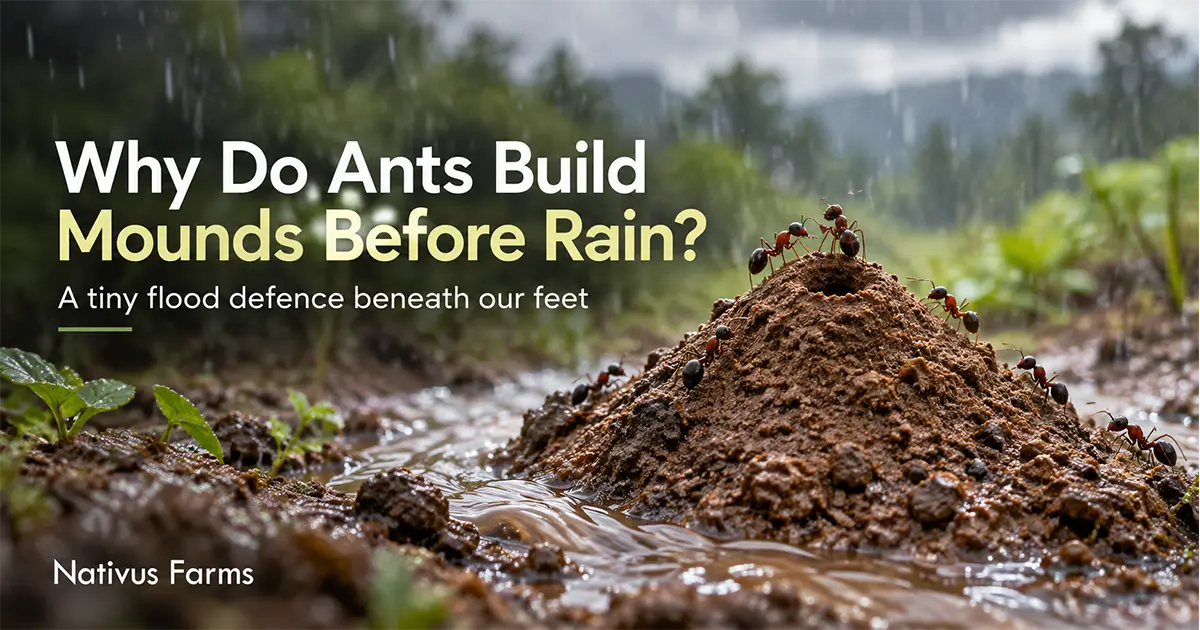
Why Do Ants Build Mounds Before Rain? The Tiny Flood Defence Beneath Our Feet
Sep
Why Do Ants Build Mounds Before Rain? The Tiny Flood Defence Beneath Our Feet
Introduction: Do Ants Really Know When Rain Is Coming?
You may have noticed a sudden change around an ant nest when the monsoon is approaching. Ants seem busier. Soil looks freshly moved. A small pile grows around the entrance. It is easy to think: the ants know rain is coming.
But there is a more interesting explanation.
For some ants, the mound is less like a weather forecast and more like a tiny piece of flood protection. Their homes may lie below the soil surface, where a heavy shower can turn a safe entrance into a water pathway. Raising and reshaping that entrance can help keep water away.
Field research on an Indian ant has tested this idea. A mound can do more than make an anthill look bigger: it can reduce water entering the nest.
So what is really happening when ants build mounds before rain?
The Short Answer: It Is About Water, Not Magic
The simplest answer is this: some ants modify their nest entrances when wet conditions create a flooding risk.
That distinction matters.
We often say that ants “predict rain”, but the evidence is more careful. Researchers have documented ants changing nest structures in response to rainfall and water around the entrance. That is different from proving that an ant knows a storm is coming hours or days in advance.
One Indian field study found that mild rainfall was followed by increased nest-entrance building in Diacamma indicum. The ants added soil around entrances and formed more substantial mounds during the monsoon. When researchers placed water around the entrance, the ants changed the entrance; adding water directly inside the nest did not produce the same significant response.
The surface conditions mattered: the colony was responding to water arriving where the entrance met the ground.
Why Is Rain Such a Problem for an Ant Nest?
To us, a few millimetres of rain may look harmless.
For an insect living in a small underground nest, the same water can become a serious engineering problem.
Many ants live in soil, using tunnels and chambers beneath the surface. Rain can collect around the entrance, run across the ground and seep towards the opening.
During heavier rainfall, water can enter the nest, damage the shelter and disrupt the colony. Monsoon flooding is a particular challenge for subterranean ants.
A 2015 field and laboratory study found that monsoon conditions changed where colonies nested and how they modified their entrances. When flooding became severe, colonies could also abandon flooded nests.
It helps to think of an ant nest as more than a hole in the ground.
It is a home that has to keep working while conditions outside keep changing.
What Do Ants Actually Change Before or During Wet Weather?
The changes can be surprisingly simple.
Ants may move loose soil towards the entrance and build it into a small mound. The Indian study also recorded plant fragments and insect remains around some entrances, while consolidated soil mounds became more common during the monsoon.
Think of the difference between a door at ground level and a door sitting slightly above the surrounding surface.
If water flows across the ground, the raised doorway has a better chance of staying dry.
That is the basic idea behind the ant mound.
A Tiny Wall Against Water
A later field experiment tested the mound itself rather than simply observing ants during the monsoon.
Researchers examined 19 nests of Diacamma indicum and found that the mound raised the nest entrance by an average of 3.39 centimetres. The entrance at the top of the mound was also smaller than the opening at the base.
Both features were considered likely to reduce rainwater falling directly into the entrance tunnel.
Researchers then measured water entering nests with and without mounds.
The mounds prevented a minimum of 29.2% of water from seeping into the nest from the surrounding area and could act like small earthen levees.
That is a striking result for a structure made from soil.
The mound does not need to stop every drop.
It only needs to reduce the amount of water reaching the entrance.
What Happens If the Mound Is Damaged?
This is where the story becomes even more interesting.
If the mound were only leftover soil, destroying it should not necessarily matter much to the colony.
Researchers tested that idea by partially and completely removing mounds from nests.
In the 2021 field experiments, all tested colonies rebuilt damaged mounds to their previous levels within three days after both partial and complete destruction.
This does not mean every ant mound everywhere is built for the same reason. Ants build different kinds of nests, and mounds can serve several functions depending on species and habitat.
But for this Indian ant, repeated rebuilding supports the idea that the mound is an actively maintained part of the nest.
The pile of soil is part of the architecture.
Can Ants Really Predict Rain?
This is the question that makes the story tempting.
The honest answer is: be careful with the word “predict”.
There is no general scientific proof that ants can forecast rain like a weather service. Some ants can respond to environmental cues, and researchers have discussed temperature, humidity and seasonal changes as possible signals. But responding to changing conditions is not the same as demonstrating advance knowledge of rainfall.
More recent research shows how strongly rain itself can affect some ants.
A 2025 study on Diacamma indicum examined how falling water droplets affected ants while they relocated between nests during monsoon conditions, adding to evidence that rain is a significant challenge for these subterranean colonies.
So instead of saying:
“Ants know rain is coming.”
A more accurate statement is:
“Some ants respond to changing wet conditions in ways that help protect their homes.”
That may sound less mysterious, but it is actually more fascinating.
The ants do not need a weather forecast. Their surroundings give them information, and the colony responds.
Why This Matters Beyond Ants
There is a bigger soil story hidden inside this tiny mound.
Ants are not passive occupants of the ground. Many species dig tunnels, move soil and build structures that change the small environment around their nests.
A global review of more than 80 studies found that ants can influence soil movement, infiltration, runoff, erosion and nutrient patterns through mound-building and underground activity.
The effects vary across species and habitats.
Still, the larger lesson is useful:
Soil is not an inert layer beneath our feet.
Earthworms move through it. Roots open pathways. Microorganisms transform organic matter. Ants excavate tunnels and move particles from one place to another.
When we look at soil only as “dirt”, we miss much of what is happening inside it.
What Can Farmers and Gardeners Learn From an Ant Mound?
There is no need to copy an ant mound directly into a farm field.
The useful lesson is the principle behind it: living systems respond to water movement, soil structure and changing conditions.
Good land management works with those same realities.
Keeping soil covered with plants or organic residues can reduce raindrop impact. Organic matter and healthy soil life can also support better water movement through the ground instead of allowing water to race across the surface.
Ants are only one part of that larger picture.
Their mound gives us a small, visible example of something farmers have always had to understand:
Water does not simply fall. It moves.
Where it goes depends on land shape, soil condition and the structures living organisms create.
That is why soil conservation is also about understanding how land receives, holds and moves water.
A Mound Is Small. The Idea Behind It Is Not.
The next time you see ants working around a raised nest entrance before or during the monsoon, look a little closer.
You may be seeing a colony responding to a very ordinary problem.
Water is coming into its world.
The ants respond by changing their home.
The ants raise the entrance and rebuild damaged structures. When flooding becomes too severe, some colonies can abandon the nest and move to safer ground.
We see a small pile of soil.
The colony is building a defence.
Nature often teaches through small details. Sometimes survival looks like a few grains of soil moved into exactly the right place.
At Nativus Farms, we believe paying attention to small natural systems changes how we look at the land around us. Soil beneath a farm, garden or footpath is not empty ground; it is a living space shaped by countless interactions.
The more closely we observe those interactions, the better we understand why caring for soil, water and biodiversity matters.
And sometimes, all it takes to begin is to stop beside an anthill when the rain arrives.
Frequently Asked Questions
Some ants build or strengthen mounds around nest entrances when wet conditions create a flooding risk. A raised entrance can help divert water away from the opening.
There is no general scientific proof that ants can predict rain in advance. Some species respond to environmental changes and to water around their nests, especially during rainy seasons.
Yes, at least in the Indian ant Diacamma indicum studied in field experiments. Its mound raised the entrance and reduced water entering the nest; one experiment found that mounds prevented a minimum of 29.2% of water from seeping into the nest from the surrounding area.
Some do. In field experiments on Diacamma indicum, colonies rebuilt partially or completely damaged mounds to their previous levels within three days.
Ants can strongly modify soil through digging, tunnelling and mound-building, and research shows these activities can affect soil structure, water infiltration, runoff and nutrient distribution. The effect is not the same for every ant species or habitat, so an ant mound should not automatically be treated as a sign of healthy or unhealthy soil.
Conclusion
An ant mound may look like a simple pile of soil, but it can be a carefully maintained defence against water. Some ants respond to changing wet conditions by raising and rebuilding their nest entrances, helping protect their underground homes from flooding.
The next time you see ants working before or during the monsoon, look a little closer. What looks like a tiny mound of soil may actually be a lesson in adaptation, water management and the remarkable life beneath our feet.