
Nature Decoded, Sustainable Agriculture
The Secret Conversation on a Maize Leaf: How Plants Respond to Caterpillar Attacks
Aug
The Secret Conversation on a Maize Leaf: How Plants Respond to Caterpillar Attacks
Walk through a field of crop plants on a warm afternoon, and everything looks quiet. However, the study of maize plant defence reveals that a hidden biological conversation is constantly taking place. Leaves rustle softly in the wind, standing firm in the soil, making it easy to assume that crops are passive targets—rooted in place, waiting for whatever comes their way.
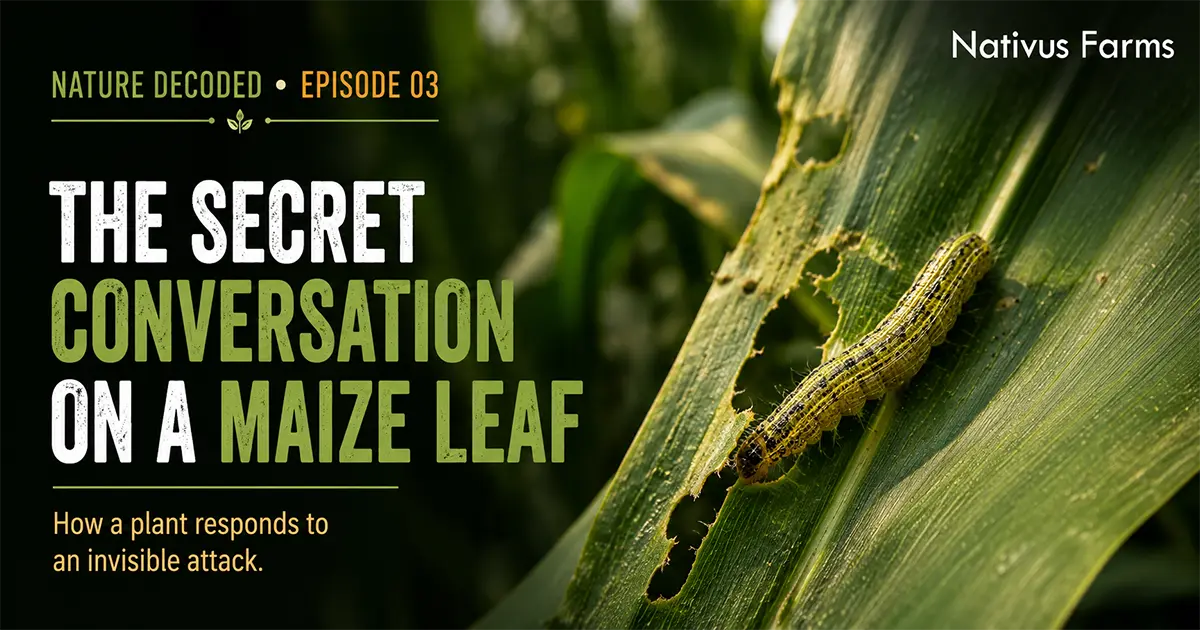
When a caterpillar climbs onto a leaf and begins to chew, that quiet image changes completely.
Beneath the surface, a rapid biological sequence begins. Without moving an inch or making a sound, the maize plant responds to physical damage with a precise chemical transformation. This subtle response can influence the behaviour of insects flying nearby.
The story on that single leaf is far more dynamic than it appears.
How Caterpillars Trigger Maize Plant Defence?
When a caterpillar bites into a maize leaf, the damage is not just mechanical. The plant does not merely bleed sap or passively lose tissue.
Instead, the plant’s cells detect specific chemical markers present in the caterpillar’s saliva, combined with the physical tearing of its leaf tissue. This triggers an immediate internal reaction.
Within minutes, internal signalling pathways fire up. The maize plant recognizes that it is under herbivore attack rather than damaged by a simple gust of wind or a passing animal.
This recognition starts a biochemical process designed to limit further harm.
The Plant Changes the Chemistry Around It
As a central mechanism of ‘maize plant defence’, the crop alters the compound mix it releases into the surrounding air once an attack is recognized.
Under normal conditions, a healthy plant secretes a subtle baseline scent. However, an attacked plant shifts its internal chemistry, synthesizing and releasing an entirely altered blend of airborne compounds.
Scientists refer to these specialized emissions as Herbivore-Induced Plant Volatiles (HIPVs).
For simplicity, we can think of them as specialized plant odours or chemical cues. Rather than remaining isolated within the wounded tissue, these volatile compounds drift off the leaf and into the surrounding air, creating an invisible plume of chemical information.
Can Other Insects Detect These Plant Odours?
Insects navigate their world primarily through smell. Antennae house sensitive chemical detectors capable of picking up trace compounds suspended in the air.
When a maize plant releases these modified odours, nearby insects can detect the shift.
It is important to view this interaction accurately: the plant is not intentionally writing a message or conscious of sending a signal. Rather, its natural metabolic response generates chemical information in the atmosphere.
For hungry predators or searching parasitoids, these airborne odours serve as reliable indicators that a potential host or meal is nearby.
The Natural Enemy Connection
The interaction between crops, fall armyworm caterpillars (Spodoptera frugiperda), and parasitic wasps provides a clear real-world example of ‘maize plant defence’ in action.
When armyworm caterpillars feed on maize, the plant emits altered chemical cues. These specific odours attract small parasitoid wasps, such as Cotesia marginiventris or Microplitis rufiventris.
It helps to distinguish between the two primary types of natural enemies:
- Predatory insects: Species like ladybirds or lacewings actively attack and consume prey directly.
- Parasitoid wasps: These beneficial insects do not eat the caterpillar immediately. Female parasitoids instead rely on chemical cues to locate host caterpillars before laying eggs inside or on them. Parasitoid larvae then control the pest population as they develop over time.
Field research shows these chemical cues significantly narrow the search area for female wasps seeking host caterpillars across a dense crop canopy.
What Scientists Have Observed in Maize Fields
Laboratory experiments initially demonstrated that beneficial insects respond to plant odours in controlled wind tunnels. However, agricultural scientists needed to know if this mechanism functioned outdoors in open fields.
Field studies confirmed that it does. Research published in journals like Proceedings of the National Academy of Sciences (PNAS) and Ecology verified that maize plants damaged by caterpillars attract higher numbers of parasitoid wasps in actual field environments compared to undamaged plants.
These field observations demonstrate that plant chemical responses remain functional despite variable wind currents, temperature shifts, and competing scents from surrounding vegetation.
While it does not guarantee instant protection for every damaged leaf, it plays a measurable role in how natural enemies locate prey.
Why This Matters for Agriculture
Understanding ‘maize plant defence’ and wider plant-insect interactions offers practical value for sustainable agriculture and natural pest management.
Industrial farming often treats crop fields as static environments that require synthetic chemical intervention at the first sign of leaf damage. However, recognizing that crops actively participate in ecological networks changes how we manage farmland.
- Integrated Pest Management (IPM): By preserving populations of natural enemies, farmers can allow biological controls to complement their crop protection strategies.
- Cropping Systems: Intercropping and maintaining field margins support beneficial wasp populations, giving them habitats near crops that release these helpful cues.
- Reducing Synthetic Inputs: Supporting natural predator-prey dynamics helps reduce reliance on broad-spectrum chemical sprays, which often harm beneficial insects along with pests.
A biodiverse agricultural ecosystem creates room for these relationships to function effectively.
Misconceptions About Maize Plant Defence
To maintain scientific accuracy, it is important to clarify common misconceptions regarding plant defence:
- No conscious intent: Plants do not “think,” plan, or deliberately call for assistance. The response is a biochemical process shaped by evolution, not a conscious action.
- No guarantee of total protection: The release of chemical cues does not mean a swarm of wasps will immediately save every plant. Factors like weather, wasp populations, and caterpillar species influence the outcome.
Factors That Influence Plant Signals
- Variability across varieties: Different maize varieties emit varying levels and compositions of volatile odours. Modern breeding programs sometimes inadvertently alter these natural traits.
- Complex environmental factors: Soil health, moisture levels, and overall plant vigor significantly affect a plant’s capacity to produce defensive chemical cues.
Recognizing these distinctions helps keep our understanding grounded in biological reality rather than sensationalized claims.
Frequently Asked Questions
No. Plants do not have nervous systems or conscious intent. The release of plant odours is a metabolic response to tissue damage and herbivore saliva that natural enemies have evolved to detect.
HIPVs are airborne chemical compounds produced and released by plants after being damaged by herbivorous insects. They alter the smell profile around the plant.
No single biological mechanism eliminates all pests. Natural enemies contribute to regulating pest populations, serving as one component of balanced, integrated pest management.
No. Chemical profiles vary across different maize lines, wild ancestors, and commercial hybrids. Environmental factors like soil nutrition and water availability also influence emissions.
Conclusion
A leaf may look still, but an entire ecological interaction unfolds around it. When a caterpillar feeds on a maize plant, the resulting chemical shift creates actionable information for natural enemies nearby.
At Nativus Farms, we believe that understanding these natural biological relationships is essential to thoughtful, scientifically grounded agriculture. Observing how crops interact with their environment helps us appreciate the balance built into healthy ecosystems—reminding us that working alongside natural processes is the most effective way forward.