
Gardening
The Ultimate Beginner Gardening Guide: Grow Your Own Healthy Food at Home
May
Imagine waking up in the heart of a concrete jungle, yet the first thing you smell isn’t exhaust fumes—it’s the earthy fragrance of wet soil and fresh mint. For many urban dwellers, “health” has become something bought in a plastic bottle or a supplement pill. Consequently, we spend our days staring at screens, disconnected from the very earth that sustains us.
Starting a home garden is more than just a hobby; it is a rebellion against a chemically-laden food system. Therefore, it is the first step toward reclaiming your vitality. However, the path from “buying a pot” to “harvesting a meal” is often paved with wilted leaves. If you’ve ever watched a sapling die within a week, don’t give up. The problem isn’t your “black thumb”—it’s simply a lack of the right foundation.
Why Most Urban Gardens Fail Before They Start
The modern urbanite faces a unique set of challenges. While we are taught to want “instant results,” nature moves at its own sacred pace. Specifically, there are three main reasons why beginners struggle.
The Disconnect from the Soil Most beginners pick up a bag of “red mud” from a roadside nursery and wonder why their plants suffocate. Because this soil is often too heavy, it lacks the microbial life necessary for a plant to breathe.
The “More is Better” Trap In our quest to be “good” plant parents, we often over-pamper. For instance, we overwater, thinking thirst is the only enemy, only to cause root rot—a silent killer that rots the plant from the inside out.
The Light Crisis Furthermore, we often place plants based on where they “look good” in our interior decor. Unfortunately, a plant trapped in a dark corner of a balcony is like a person trapped without oxygen.
Vrikshayurveda: The Ancient Science of Plant Health
Long before modern agricultural science, Indian sages practiced Vrikshayurveda (the science of plant life). They understood that a plant is a living being with a Dosha balance, just like humans.
Restoring the Life Force In Ayurvedic tradition, the soil is the “prakriti” (nature) of the plant. If the soil is depleted, the food grown in it will lack Prana (life force). This is why traditional Indian farming uses substances like Panchagavya—a blend of five cow-derived ingredients—to not just “feed” the plant, but to energize the entire ecosystem.
Cultivating Vigor at Home By treating your garden as a sacred extension of your home, you aren’t just growing vegetables. Instead, you are cultivating Ojas (vigor) in your immediate environment.
Why You Need a Home Garden Today
- Pesticide-Free Nutrition: Commercial “organic” labels can be misleading. However, when you grow it, you guarantee zero synthetic toxins.
- Microbial Diversity: Touching soil has been scientifically proven to release serotonin. As a result, this boosts your mood and your human microbiome.
- Stress Reduction: Balcony Gardening acts as a meditative practice. Consequently, it helps in lowering cortisol levels and blood pressure.
- Hyper-Fresh Flavors: Vegetables lose nutrients within hours of harvest. In contrast, your garden ensures the time from “soil to plate” is only seconds.
Sourced from the Heart of the Farm
At Nativus Farms, we don’t just sell products; we bridge the gap between the traditional farmer and the urban home. We spent years working with natural farmers who still use the “Earth-First” method.
Learning from the Land They taught us that you cannot cheat nature. For example, you cannot replace centuries of soil-building with a quick-fix chemical spray. Therefore, our products are sourced directly from these stewards of the land.
Ensuring Purity This ensures that the Premium Vermicompost you use in your apartment is the same high-potency nourishment used on real, thriving natural farms.
Your Step-by-Step Beginner Gardening Guide
Step 1: Master the Soil Mix First, don’t use garden soil alone. Create a mix that is 1/3 compost, 1/3 coco-peat, and 1/3 soil. This ensures better aeration and drainage.
Step 2: The Finger Test for Water Secondly, stop the schedule! Instead, stick your index finger an inch into the soil. If it’s dry, water it. If it’s sticky, walk away.
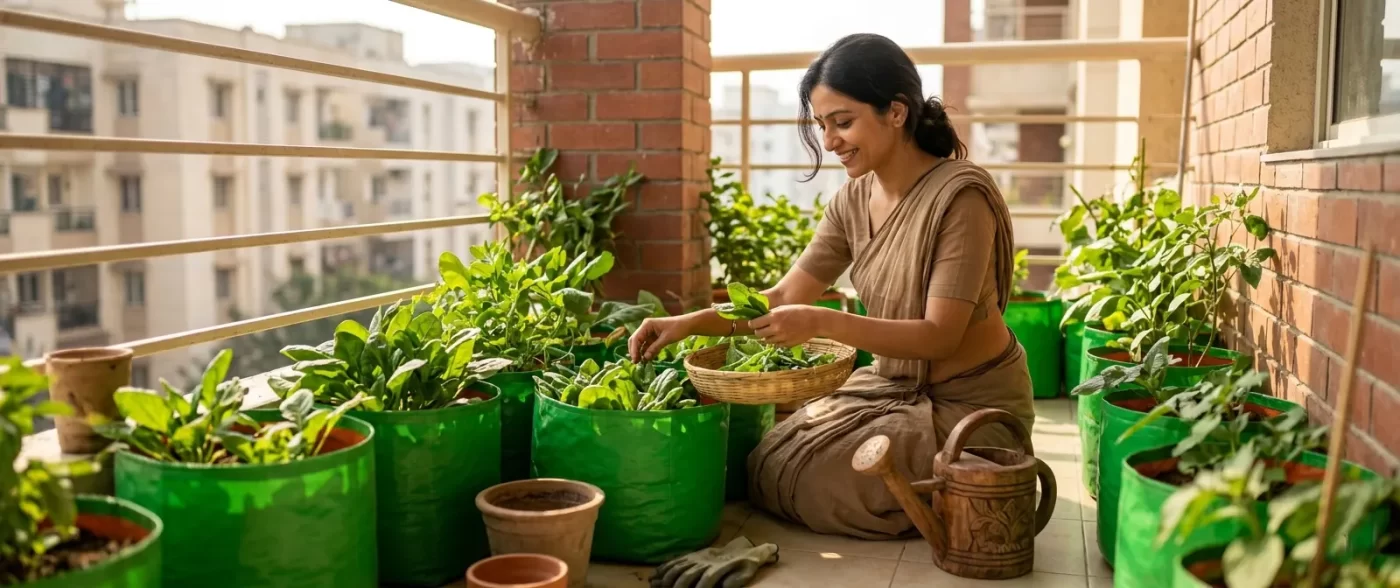
Step 3: Sunlight Mapping In addition, observe your balcony. Most vegetables need at least 4–6 hours of direct sun. If you have low light, stick to leafy greens like Spinach.
Step 4: Use “Breathable” Containers Finally, use high-quality grow bags. Because plastic pots heat up in Indian summers, they can “cook” the roots.
Essential Tools for Your Green Journey
To ensure your success, we’ve curated a “Starter Kit” based on natural farming principles:
- The Foundation: Use our Premium Vermicompost to enrich your soil. Specifically, it acts as a probiotic for your plants.
- The Right Home: For greens like Palak, our Premium HDPE Grow Bags provide the perfect depth.
- The Growth Booster: Give your plants a dose of wisdom with Organic Panchagavya Liquid Fertilizer.
- Natural Protection: Additionally, our Organic Neem Oil keeps pests away safely.
- The Finisher: If leaves look yellow, use Magnesium Epsom Salt Fertilizer to balance mineral deficiencies.
Ready to transform your balcony into a living pharmacy? Don’t wait for “someday” to start eating healthy. Your journey to a chemical-free life starts with a single seed.
FAQs
Q1: Can I start a garden in a small apartment? Absolutely! Balcony Gardening is perfect for apartments. However, make sure to focus on vertical space and lightweight grow bags.
Q2: How often should I fertilize my home garden? Generally, a handful of organic manure every 15 days is sufficient. Furthermore, using a liquid stimulant once a month can boost yields.
Q3: Which plants are best for beginners? Start with Mint or Coriander. Because they grow quickly, they give you the “win” you need to stay motivated!
CONCLUSION
In summary, gardening is not just about growing food; it is about growing yourself. By following this Beginner Gardening Guide, you are aligning yourself with the rhythms of nature. Start small, use natural inputs, and listen to your plants. Consequently, you won’t just be a gardener—you’ll be a producer of your own health.